Featured Post

The white-Left Part 1: The two meanings of white

Friday, January 13, 2012

The Current Situation in Libya

I have been planning forever to do a follow up diary on Libya. If you have been following me here you know that no sooner than the Libyan revolution was moving into the clean-up phase of the military campaign, that I found my focus dramatically driven to downtown Los Angeles. Even the death of Mummar Qaddafi became a footnote to events.

I had already done all that I knew to support their revolution from afar, and while, in the age of the Internet, not all politics is local, most of it still is. Occupy Los Angeles became my new beat. Anyway, it seemed that the longer I waited to do this diary, the better and more solid the news became. Then today an interview with Ali Ahmida came out and it is absolutely the best summation I've heard on the current situation in Libya. More about that below the fold.

I never entirely lost track of events in Libya and mostly I have been very pleased with what is happening and the progress they have been making.

Even the question of the armed militias that is the big bugaboo that most commentators of the left and right, not to mention the present Libya government and the TNC, seem to worry so much about, doesn't bother me that much. Certainly it can be a major problem if they start fighting among themselves, and that is why everyone wants them gone. You beat Qaddafi. Good. Thanks. Go home. Get a regular job.

On the other hand, they made this revolution, they truly are a people's army and many of them say they are not ready to lay down their arms until they can be sure they get the government they have been fighting for. I support that position, as long as they don't start fighting among themselves.

So I have had a close ear to the ground, as have most Libya watchers, for signs of conflict. I saw a tweet "Gun fire, not celebratory, many areas of Tripoli" in mid November, but could find no corroboration. There was another incident, not widely publicize, on December 11, between a Zintan militias and the Libyan army over control of the Tripoli airport in which four people were killed and this more recent incident in Tripoli in which five people were killed. I heard three different stories about that. One said someone from Tawergha assaulted someone from Misrata, was arrested by the Tripoli brigade, then the Misrata brigade tried to take custody and a fight broke out. Another story also called it a fight between those two brigades but for a different reason. And the third story was that it was simply a robbery gone wrong and the robbers shot it out with the Tripoli brigade.

That is all I've heard about since October, nine people killed in inter-militias fighting in this country of 7 million in this immediate post military phase. I think that is pretty damn good; which is to say I think it compares very favorably with the number of people killed in inter-gang warfare in Los Angeles in the same period. So I don't worry too much about the militias because the militias, they call themselves brigades, seem to be handling things very well to this point.

I also think their decision to accept air support from NATO, and consequently, my support for that decision, has been proven correct. According to a recent NY Times study spotlighted on Democracy Now, NATO killed between 40 and 70 civilians in its Libyan campaign. Those sources tried to make the most of that, describing the deaths of some of those in passionate detail, but I think that is remarkable. The number could be double that and my conclusions would still be the same. 30,000 Libyans died in that war. The vast majority were killed by Qaddafi's forces, many while in his custody. Certainly, NATO killed thousands of Qaddafi soldiers, but those soldiers were killing other Libyans, mostly civilians, so by doing that they almost certainly saved many Libyan lives and shortened the war.

So there were no massive civilian causalities from NATO bombs as the anti-interventionists predicted, and there were no NATO boots on the ground, as the anti-interventionists predicted.

I know, I know. There may have been spooks. There was a CIA station there even before Feb17, I'm sure they never left. Special forces? A lot of speculation but very short on proof. Even Qaddafi claimed to have captured 17 foreign special forces in Sirte, video to follow. It never showed up. Besides that's not what the anti-interventions were talking about in the beginning. That just became their fall back position because the Marines never made it back to the shores of Tripoli.

Libya just had $87 billion unfrozen by the EU and oil production is already coming back on line, so I think their financial problems will quickly be resolved. Not many countries can say that these days.

Another thing that is becoming clear now is just how little real support Qaddafi had. While there was that one sneak attack against an oil terminal while Qaddafi was still alive, there has been nothing since. The guerilla war by Qaddafi supporters against the revolution has simply failed to materialize, and while wavers of the green flag still have had some freedom to demonstrate openly, as this video illustrates, there just haven't been very many of them.

And I was personally very please to find that my mention of Racism in Libya at the end of my recent diary on Occupy Nigeria led to a new round that that article being retweeted among Libyans.

So I think things are shaping up nicely in Libya. I don't even worry about the Islamic Brotherhood or other Islamic forces coming to power, not in Libya or anywhere else in MENA. That is part of democracy and maybe that is something they have to go through so that they can grow out of it. How long will we have to suffer the Republicans?

Still there is all the minutia of building a new revolutionary Libya, and for more on that, I turn the floor over to Ali Ahmida.

Today my worlds come together. At 10:30am I go back to Africa. There is an Occupy Nigeria protest in Hollywood organized by Nigerians of Southern California. Then at 1:00pm there is a Southern California Occupy Meet Up in Long Beach. It'll be a busy day.

Current Political Situation in Libya: An Interview with Ali Ahmida

Libya is back in the news with increasing tensions among various militia groups and political factions struggling for power, sometimes through street battles.

Three months have passed since the regime of Muammar Qaddafi was dislodged in Libya. So what is happening in Libya today? What forces are in play, and what has become of the revolutionary militias? And what about the issue of outside influence in today's Libya, given the crucial role played by NATO forces as well as governments such as Qatar in bringing an end to Qaddafi's autocracy.

Khalil Bendib spoke with University of New England political science professor Ali Ahmida, who just returned from Libya.
Current Political Situation in Libya: An Interview with Ali Ahmida by Jadaliyya
Click here for a list of my other blogs on Libya

Tuesday, January 10, 2012

Occupy Nigeria - 1st African fruits of Qaddafi gone?

Follow #OccupyNigeria on twitter for the latest news.

Uploaded by AnonymousNigeria on January 9, 2012

”Out of Africa always comes something new” wrote the Roman historian Pliny, (23-79 A.D.) With Mummar Qaddafi gone from Libyan, this old adage will almost certainly gain new meaning because Qaddafi was not only the dictator who ruled Libya with the whip for 40 years, he was a major power in African affairs. He sought to unify Africa under his leadership and saw himself as "King of all the African tribes." Well, with the kickoff of Occupy Nigeria, we are seeing something new in Africa today.

Nigeria is the most populous country in Africa, 160 million people or 1 in 6 Africans live in Nigeria, so any movement there is bound to have a big impact on the whole continent. Could this have anything to do with Qaddafi's recent demise and the success of the revolution in Libya? These are the main questions I wish to touch upon in this article. But first a quick update for those that have not been glued to news out of Africa all day.

3 people were killed and at least another 20 were injured as Nigerian state security used tear gas and rubber bullets and finally resorted to live ammunition in attempts to suppress mass protests in Lagos and other major cities in Nigeria. Except for the rallies, the streets were eerily empty, and shops and businesses closed as most of the country was brought to a grinding halt by a nationwide general strike which its organizers have named "Occupy Nigeria."

This nationwide general strike was sparked by the government's decision to discontinue fuel subsidies. This resulted in a more than doubling of gasoline prices overnight. Nigeria exports more crude oil than any other African country, but only has refinery capacity for 25% of its own needs. It must import, at great expense, most of the gasoline it uses and the government subsidies make the cost bearable in a country where most people live on less than $2 a day. In fact, most Nigerians see the fuel subsidy as the only benefit of being an oil rich nation that trickles down to ordinary people.

Al Jazeera English has been giving good coverage to this story. For more details and background I would recommend Nigerian fuel protests turn deadly

Here are two YouTube Videos of today's action
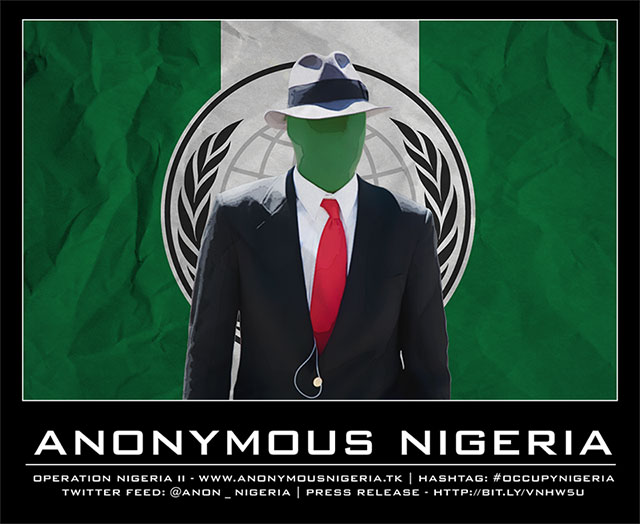
It is so symbolic of the way this movement has circled the globe in one year that they have named it Occupy Nigeria because this is an obvious nod to Occupy Wall St. and the occupy movement which got its impulse from the Arab Spring which began in another African country, Tunisia, just north of Nigeria. It was also just about a year ago, on Jan. 2, 2011 that the hacker group Anonymous launched OpTunisia in support of the people's struggles in Tunisia. On Jan. 5, 2012, The Naija Cyber Hactivists in conjunction with the allied forces of Anonymous announced Op Nigeria, which had been running since at leat May 2011, was moving in support of Occupy Nigeria by defacing the website of the Federal Ministry Of Transport. Over the weekend more Nigerian government websites were defaced by NCH including the National Insurance Commission [owned], National Information Technology Development Agency [owned] and MNNA [owned] It is very significant that Occupy Nigeria is taking place all across the country and has been able to unite people across tribal, ethnic and religious lines. Nigeria has a long history of religious strife that has threatened to tear the country apart. Most recently Nigeria was in the news because of the Christmas bombings of Christian churches by the Islamic extremist group Boko Haram. Those terrorist attacks killed dozens of Nigerians. For historical reasons Nigeria has been pretty evenly divided between Muslims and Christians with the Muslims concentrated in the North and the Christians concentrated in the South. This religious difference has been the main locus of conflict in Nigeria with most of the North states implementing Sharia law and the indigenous Salafist group, Boko Haram trying to be the Taliban of Nigeria. The demise of Qaddafi and the events in Libya almost certainly have something to do with this recent upsurge in activity by Boko Haram. Mummar Qaddafi may have been for uniting all of Africa but he was also for the break up of Nigeria. From his position as president of the African Union, he advocated the division of Nigeria into separate Muslim and Christian states and at the same time he worked to unite all of Africa into one Muslim state. It is now very clear that he did much more that just speak in favor of the break up of Nigeria. He put his money, meaning Libya's national treasure, were his mouth was. Kingsley Omonobi of Abuja, Nigeria wrote on the Vanguard website days after Qaddafi was killed:
Slain Libyan leader, Col. Muammar Gaddafi was a major sponsor of terrorism activities and religious fundamentalism in the country, resulting in his supply of arms and ammunition to sectarian groups during religious uprisings, terrorist attacks and even the post elections violence that rocked the nation soon after the 2011 presidential elections, Saturday Vanguard has learnt. Security sources disclosed that they had been aware of the intention of Col. Gaddafi to instigate the destabilization of Nigeria with a view to bringing to fruition, his proclamation early this year, that Nigeria would disintegrate into several parts unless the country was divided into two, with North going their own way and the South forming their own country. Saturday Vanguard was told that it was in his bid to make this happen, that Col Gaddafi massively funded the construction of Mosques and other Islamic Centers of worship in Kano and other cities of the North. He was also said to have embarked on several humanitarian donations and visits to Kano and these other Northern states, most times unannounced, after which he would journey back to his country. “There were also several visits by several top and influential Northerners, especially those of the Islamic faith to Libya ostensibly on the invitation of the late Libyan leader when he was alive and held sway in Tripoli before the revolution against him started which security agencies were aware of and we closely monitored these persons”, the source said. It is against this backdrop and that of several well documented destabilization plots, allegedly sponsored or supported by the late Libyan leader, Saturday Vanguard gathered, that Nigeria moved swiftly in recognizing the National Transition Council after Gaddafi had fled Tripoli... Asked to give an example of how and when the security agencies discovered Gaddafi’s plan against Nigeria, the source said, “As far back as 2003 and 2004, some armed bandits who had been terrorizing Adamawa, Yobe, Kano states, were caught with about 40 double barrels, lethal rifles, machine guns and ammunition. After investigations, and coupled with confessions from the suspects, the weapons and ammunition were found to have a special Gaddafi insignia on them.” So why did Nigeria keep quiet all these years till Gaddafi had problems with his people? The source said he was not in a position to explain, adding that such answer can only come from the federal government.
One example: Mujahid Dokubo-Asari, head of the Niger Delta Peoples Volunteer Force was one such Qaddafi trained Nigerian separatist. For many years he led a violent campaign to turn Nigeria's oil rich Niger Delta into an independent republic. He was born a Christian but converted to Islam. He was trained in Libya in 1990 and 1991. He told AFP
"I was invited by the Libyan government and given a scholarship to go study Islam," he said. "When I arrived in Libya, they thought that I had revolutionary ideas, so I became close to the leadership and I started talking to them."
He talked to Gaddafi as late as 2010 and has acknowledged receiving money from him but now that Qaddafi is dead he says his movement is on "sabbatical." Another Nigerian commentator saw it this way:
Gaddhafi was the chief sponsor of terrorist activities in the Niger Delta and in the North. Listen to Asari Dokubo and you will see reasons. Now he's gone, no more funds for them to carry out terrorist attacks against the state of Nigeria.
As might be expected of one who fashioned himself king of all Africans, Mummar Qaddafi had a long history of cultivating close ties with Africa's most populous state and while Nigeria doesn't share a common boundary with Libya, it is very easy to travel overland between the two without much government interference. The countries in between, Niger, Chad, Mali, Burkina Faso and Northern Sudan all are weak states with little or no control of their international boundaries. Nigeria, for example has over a thousand border entry points but only 25 of those are peopled! Nigerian immigrants regularly made the perilous journey to Libya in search of work. Some of that work ended up being fighting in Qaddafi's mercenary army. According to Agaju Madugba in September:
"More than 200 Nigerians were arrested in Libya by the TNC, while about 20 were executed last week on allegations of supporting Gaddafi, as mercenaries."
Three are known to have died in his service. More have returned to Nigeria now that the fighting has ended, along with thousands of Nigerian immigrant laborers displaced by the upheaval in Libya. There has also been a problem with Libyan weapons showing up in Nigeria now that they are being used less in Libya, and more significantly, some of Qaddafi's senior leadership is said to have fled to Nigeria. All of this has no doubt had a destabilizing effect on Nigeria, but it is mostly a short term effect. Even the recent carnage created by Boko Haram can probably best be seen as a rather desperate explosion by a movement that just lost a major sponsor and knows that it will soon be weaker. These immediate problems will be quickly overcome in the face of the unity being expressed in Occupy Nigeria. The important thing is that with Qaddafi gone, a major opponent of Nigerian unity has been removed. That is why Ochereome Nnanna could speak of,
the unbridled sense of euphoria sweeping Libya and even Nigeria at the fall of a man who dominated his country – and to some extent, the continent – for 42 years.
and why yesterday Emmanuel Iduma titled his blog on Black Looks:
See, The Nigerian Revolution Has Begun
Uploaded by AnonymousNigeria on January 4, 2012 My other pieces related to this story: Helter Skelter: Qaddafi's African Adventure Racism in Libya
Sat Mar 24, 2012 at 10:08 PM PT: In the north, the struggle against Boko Haram is getting fiercer. This was just yesterday:
MAIDUGURI, Nigeria (AP) — An hours-long gun battle raged Saturday in a northern Nigerian city that's the spiritual home of a radical Islamist sect, and a car bomb exploded during a gun fight with members of the group in another city in the restive region, authorities said. At least six people were killed.
Recently the sect rejected efforts to began indirect talks with the government and now the government is pressing its military campaign against them with renewed vigor.
Meanwhile the Occupy Nigeria movement, like the occupy movement everywhere, continues its growth outside of the lime light, as example by this article two days ago: Occupy Nigeria: Nneka on the "Vagabonds in Power" or this one from five days ago: Occupy Yourself, Occupy Nigeria By Malcolm Fabiyi

Occupy Nigeria Hollywood Protest

Follow #OccupyNigeria on twitter for the latest news.
There was a small protest rally in Hollywood on Saturday of Southern California Nigerians and other supporters of Occupy Nigeria, the Nigerian General Strike demanding the reinstatement of fuel subsidies recently dropped at the behest of the International Monetary Fuel. I shot some video and photos with my DroidX. This is the video I made:
Occupy Nigeria Hollywood Protest. January 14, 2012

Nigerians in Southern California (NISC) held a rally on Saturday, January 14 at 10 A.M @ 6430 W Sunset Blvd, Los Angeles, CA 90028-7906 (Near CNN Building) to decry the oil subsidy removal by the government of President Goodluck Jonathan. In a statement the group sent a specific message to Mr. Jonathan, reminding him that
“A leader who demands loyalty, but offers nothing in return builds tyranny; and tyranny offers nothing but failure. Empower every citizen, and you will gain strength. Offer security and justice in the form of liberty, allowing every citizen to be safe from conviction without cause or prison without charge - to work, eat, and live on the sweat of his or her own brow – and you will be great. Not only will you receive the loyalty of your people, but their love as well. GEJ, this is your chance to be great - don't waste it. Lead from the heart.”
The statement further said:
Describing the hardship that removal of the oil subsidy removal will bring to the average Nigerian, NISC said the government should:
  • Revamp all the refineries and build new ones;
  • Provide regular power supply;
  • Provide public transportation systems such as railways;
  • Repair the roads;
  • Eliminate the corruption associated with supply and distribution
    of petroleum products in
  • the downstream sector of the oil industry;
  • Trim excess wages and entitlements allocated to high government
    officials;
  • Adhere to the rule of law;
  • Be transparent;
  • Be accountable;
  • Govern well; and
  • Lead by example
Here are a couple more videos of this event. FACEBBOOK VIDEO OF OCCUPY NIGERIA..LOS ANGELES SOLIDARITY RALLY See also: Occupy Nigeria - 1st African fruits of Qaddafi gone?
8:16 PM PT: This just in. From Al Jazeera:
Nigerian unions call off national strike
Union leaders in Nigeria have called off a week-long nationwide strike that has been paralysing the country's economy, following a decision by President Goodluck Jonathan to roll back fuel-price increases.
Jonathan announced on Monday that he would reduce fuel prices in response to protests and strikes that sprang up after his government withdrew fuel subsidies at the beginning of January.
But his announcement failed to quell all of the protests, and soldiers reportedly used force to shut down demonstrations in Lagos, the country's commercial capital.
Under Goodluck's new plan, the Nigerian government will reduce fuel prices by 30 per cent, to around $2.75 per gallon, by restoring some of the subsidies. That price is still considerably higher than the roughly $1.70 per gallon Nigerians paid before the subsidies were removed.

Friday, December 30, 2011

The Year in Review: They should have left that street vendor alone!

Operation Tunisia: recruiting starts 2nd January 20112011 actually started on December 17, 2010 although none of us knew it at the time. On that provident day a fruit peddler in Tunisia decided that he was mad as hell and not going to take it anymore. In the year since then, his sentiment has been echoed by millions around the globe in the greatest show of people power that we have seen in more than 40 years.
Mohamed Bouazizi, who could find no other work and took to selling fruits and vegetables, had grown tired of the police harassment. When his complaints to city hall went unanswered, he doused himself with gasoline and lit a fire that is blazing still.

Had his act of defiance happened in any earlier epoch, it most likely would have gained little notice outside of word of mouth, but we now live in an age when word of mouth spans the globe. We have the technology, even in North Africa.

So news of his defiance spread throughout Tunisia in a flash and the people rose up to demand justice from the government. Then, via WikiLeaks, the Tunisian people found out just how corrupt their government really was and started to demand an end to the 20 year rule of Ben Ali. When they did this, their struggle took a revolutionary turn.

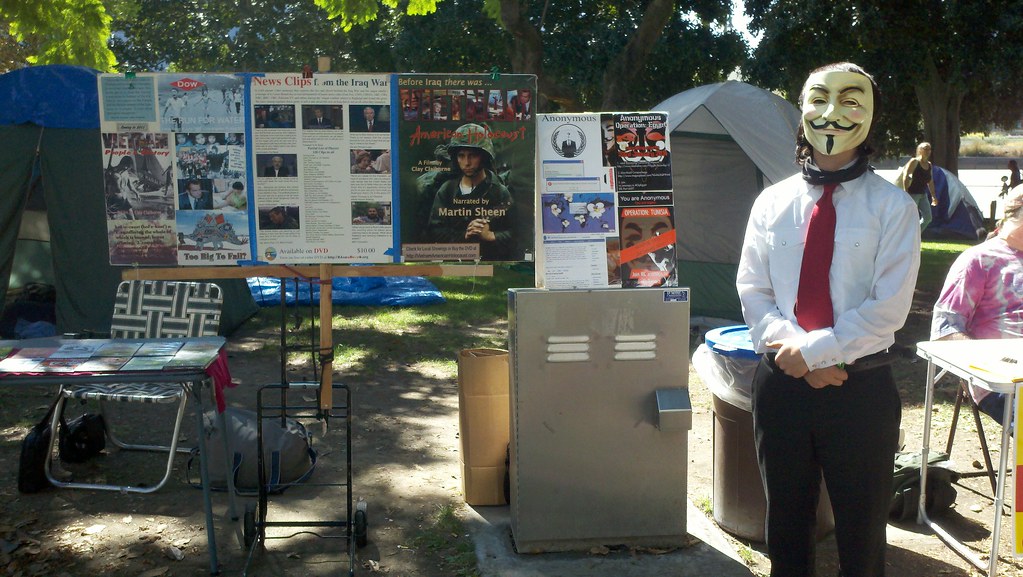
The source of that revelation was an unlikely one. A group of hackers, computer nerds, that made it their business to make government and corporate secrets public, with the aid of another hacker inside the digital pentagon, released the US State Department Tunis Embassy cables that gave details supporting what everybody already suspected about the president-dictator. Then on the 2nd day of the new year, the hacker activist group Anonymous, led by its Tunisian members, organized international support for this uprising with #OpTunisia, mainly by spreading the word, keeping the people's lines of communications up while disrupting government PR efforts and gathering Intel.

By the middle of January, Ben Ali was getting out of Dodge and protests were breaking out in Libya and Algeria. By the end of January, Egypt was fully involved and the world knew that it would be an Arab Spring. The global activist network in support of these struggles was also rapidly developing. A dense network of websites, YouTube pages, facebooks pages, Twitter accounts and other Internet resources had to be managed. The technology progressed within the year too. Cell phone cameras and YouTube were the weapons of choice from Tunisia through Libya but by Occupy Wall St., smart phones and live streaming video were coming into their own. Twitter was everywhere. The lessons of the struggle spread rapidly. In Egypt, Anonymous responded with #OpEgypt and when Mubarak tried to cut the Internet, Google came up with Speech-to-Tweet.

Before February 2011 was half over, a second dictator, Egypt's Mubarak was forced to end his 30 year rule. More protests sprung up in Yemen, Bahrain, Jordan, Palestine & Syria. Things were moving very fast. #OpLibya and #OpAlgeria were actually discussed in Anonymous before #OpEgypt demanded their attention. I think most in the global activist network that grew up to support the Arab Spring thought Libya or Algeria would be next, Egypt was the big enchilada and would be much later, but things were already moving at lighting speed. I made my contribution mainly in agitprop work, writing in the DailyKos and then joining the staff of WikiLeaks Central, where my beat was Tunisia, Egypt, Algeria and Libya. Libya became my longest self-assignment and so far, the toughest dictator to crack.

In Libya, the Arab Spring finally met a dictator that had an army that would massacre its own people when ordered to, something the armies in Tunisia and Egypt had refused to do. Because of this, the Libyan people were forced to make their revolution the old fashion way, by armed struggle. They built a true people's army, the Libyan working class - armed, and with some help from above by western interests keen to get the oil flowing again, they vanquished a brutal dictator that had savaged Libya for more than 40 years. The new government estimates that the civil war cost some 30,000 Libyan lives and, according the Democracy Now and the NY Times last week, less than a hundred of those were civilians killed by NATO. The Libyans won their liberation at the greatest cost of any in the Arab Spring, but they also won the most thoroughgoing revolution of them all, the only one in which the old army and all institutions of the old regime have been abolished.

With Qaddafi leading the charge, the response of regimes in Yemen, Bahrain and Syria veered toward the use of live fire and military power on peaceful protests. Rivers of the people's blood watered the Earth in 2011 as a result, but nowhere did the people back down or let up. More than 5,000 protesters have been murdered by the monster Assad in Syria this year and still they keep coming. 70,000 protested in Homs Tuesday and 40 more were killed.

As the year progressed, the struggle exampled by the people of North Africa began to be taken up all over the world. When they went to the streets in Belgium, they spoke of Tahrir Square. In Greece and Spain, massive numbers took to the streets to protest austerity measures. In Chile, and London students went on strike. In Bolivia, they took the protest on the road. I even saw a Guy Fawkes mask in a Moscow demonstration this week.

Twitter became the communications tool of choice for activists all over the planet. Facebook played an important role too, but so did chat, piratepad and other less well known means of digital collaboration. For a while an innocuous Egyptian dating site was a place beneath the radar where a lot of revolutionary "hook-ups" took place. Google brushed up their Arabic translation capabilities a little more than a year ago as in anticipation, and again in Libya they provided that important Speech-to-Tweet service when Qaddafi tried to cut the cord.

During the long Libyan struggle this global support network of information activists began discussions and planning to bring the Arab Spring home. WikiLeaks Central initiated the US Days or Rage campaign in March. Anonymous also started making plans, AdBusters started a campaign and the Occupy Wall Street movement was born out of this network just as the Libyan struggle was being brought to a successful conclusion, Occupy Los Angeles started on October 1st, and together with hundreds of similar occupations all over the planet, Occupy Venice started soon afterwards. The Arab Spring had come home.
Occupy Los Angeles, Day 8
Tasks of the Coming Year


Abraham Lincoln once called the United States the "Last Best Hope of Earth." He was wrong. He was exaggerating. While ending slavery was important and even preserving the union had some progressive value, it was still too early to speak of last chances. The Earth was still a little too young then but things have change greatly in the 150 years since he made his claim and 2011 has shown us something else, it has shown us how desperate the plight of the planet now is.

From Japan we learned what a disaster nuclear power is, all across the planet thousands lost their lives and livelihood as global warming flooded some areas while drying up others. Imperialist wars expanded in Afghanistan and Pakistan. In the so-called advance countries, millions of people went unemployed and homeless while the bankers fiddled and the world economy burned. It is no longer a question of hyperbole to speak of last chances for the planet because we are all staring into the abyss.

But in 2011 we also saw this revolutionary spirit, which really is the "Last Best Hope of Earth" come clear around the globe and into our backyards. Let us all work to make 2012 a year of even greater triumph for the people's movement, 2011 was only the beginning. This planet can only be saved if world finance capital is overthrown and the home of finance capital is still the United States. We are still in the belly of the beast. Let's make 2012 the year of the American Spring.

Happy New Years,
now get busy.

Clay

Follow clayclai on Twitter

If you are in Southern California, I hope to see you at Occupy the Rose Parade on January 1st and 2nd.


Occupy the Rose Parade

Saturday, December 24, 2011

Democracy Now & Amy Goodman gets it wrong again.

The leading segment on Thursday's Democracy Now [12/22/2011] carried the headline:
NATO Forced to Admit Air Strikes Killed Dozens of Libyan Civilians, Contradicting Initial Denials
The report begin:
JUAN GONZALEZ: NATO is admitting for the first time Libyan civilians were killed and injured during its seven-month bombing campaign that led to the ouster and death of Libyan leader Muammar Gaddafi. NATO made the acknowledgment after a New York Times investigation revealed at least 40 civilians, and perhaps more than 70, were killed by the bombing raids. The New York Times reports the victims include at least 29 women or children, who often had been asleep in homes when the ordnance hit. Others were killed when NATO warplanes bombed ambulance crews and civilians who were attempting to aid the wounded from earlier strikes.
The segment featured two heavy hitters from the NY Times that had just done a story on the same subject. They both repeat the point that NATO had failed to take responsibility for civilian deaths before this:
ERIC SCHMITT: Well, the principal findings, as your introduction has suggested, was that initially NATO had said, and the Secretary General of NATO had said, that throughout the seven-month air campaign, they knew of no confirmed civilian casualties on the ground as a result of NATO air strikes.
and
C.J. CHIVERS: NATO has withheld details on most of the errors and labored to portray its role in the war as all but flawless. Until this month, it insisted it had not confirmed the killing or wounding of a single civilian.
There is a problem with this retelling of history. It is wrong on the facts.

NATO had already publicly acknowledged responsibility for civilian deaths caused by an air strike in Tripoli in late June. The Guardian ran the story on Sunday 19 June 2011:
Libya: Nato admits civilian deaths in Tripoli air raid

Nato has admitted it was responsible for an air strike that killed civilians in Tripoli over the weekend.

"A military missile site was the intended target of air strikes in Tripoli last night," a statement said. "However, it appears that one weapon did not strike the intended target; there may have been a weapons system failure which may have caused a number of civilian casualties."

Earlier the Libyan government had said that a Nato missile had struck a house in a residential area of the Libyan capital, killing at least nine civilians, including two children.

The attack is the biggest mistake by coalition forces during the four-month campaign, at a time when Nato has been trying to increase the tempo of operations against the Libyan leader.

"Nato regrets the loss of innocent civilian lives and takes great care in conducting strikes against a regime determined to use violence against its own citizens," said Lieutenant-General Charles Bouchard, commander of Operation Unified Protector. "Although we are still determining the specifics of this event, indications are that a weapons system failure may have caused this incident," he added.
There may have been other such reports from NATO but I remember this story because I used it in one of my diaries about Libya at the time, so Thursday the more that I heard them repeat that "NATO is admitting for the first time Libyan civilians were killed", the more I thought it important to correct this error before it gets repeated so often that it becomes legend.

At the NATO press briefing after the tragic June 19th attack, NATO Spokesperson Oana Lungescu said:
Clearly, the main issue for NATO over the weekend and yesterday are the allegations of civilian casualties. Mike will provide more operational information, but it's important that we put those allegations in context of the NATO mission.

Each and every civilian death is a tragedy. On Sunday, due to a technical failure, one of our weapons did not strike the intended military target, which was a missile site. We deeply regret this tragic accident.

Speaking to the media yesterday the Secretary General personally conveyed his condolences to the families of all those who may have been involved, and I would like to do that again today.
To booster the DN claims on Thursday, Juan Gonzalez, even quotes "Anders Fogh Rasmussen, Secretary General of NATO, speaking in June.":
We have carried out this operation very carefully, without confirmed civilian casualties.
But this was a quote from June, no doubt before this tragic, but admitted, accident.

And in fact, the day after the accident, the NATO Secretary General was all over the media apologizing in person, this report was typical:
Nato boss regret at loss of life in Tripoli - Channel 4 News
Monday 20 June 2011
Nato's Secretary General Anders Fogh Rasmussen tells Channel 4 News he regrets the "tragic loss of life" following an off-target air strike in Tripoli, but says the mission is meeting its objectives.

Even Democracy Now reported on it at the time, making Amy's current amnesia even more remarkable:
NATO Bombs Libyan Home, Killing Nine Civilians, Including Two Babies

NATO warplanes have bombed a home in a residential section of Tripoli, killing nine civilians, including two babies. Libyan officials said another 18 people were injured. NATO admitted to carrying out the strike but blamed the bombing on a "weapons systems failure." A Libyan government spokesperson described the NATO strike as a "pathetic attempt to break the spirit of the people of Tripoli."
So, Amy, just how do you square the DN claim in June that "NATO admitted to carrying out the strike" that killed nine civilians with the current DN claim that "NATO has admitted for the first time Libyan civilians were killed and injured during its seven-month bombing campaign?"

The claim that the NY Times investigation finally forced NATO to admit something it has never admitted before became the headline, because if the truth be told, the finding that NATO killed as many as 70 civilians, and possibly more, is hardly the indictment of NATO they were looking for.

While every single civilian death is a tragedy and each individual story, some of which were told on the DN segment, is heart rending, 70 civilians killed by NATO means that the overall NATO effort saved civilian lives when it is considered that Qaddafi killed more than 10 times that number of unarmed civilians in a single night in Tripoli and the revolutionary Libya government put the total war dead at over 30,000.

Now I know that certain factions in the US left took the early approach to the Libyan revolution that if NATO supported it they were against it. Their singular focus in this struggle was patriotic opposition to NATO, veering on support for Qaddafi. They predicted massive civilian causalities as a result of NATO bombing. They also expected that it would lead to NATO troops in Libya and the complete domination of post-Qaddafi Libya by the western powers. None of this has happened.

Now we see attempts to remember the story in such a way that it supports the views they had all along, and while they are entitled to their own opinion, they are not entitled to their own set of facts.

Orwellian re-writing of history, which is what Democracy Now engaged in on Thursday's show, must be strongly opposed whether it is done by the right or the left.