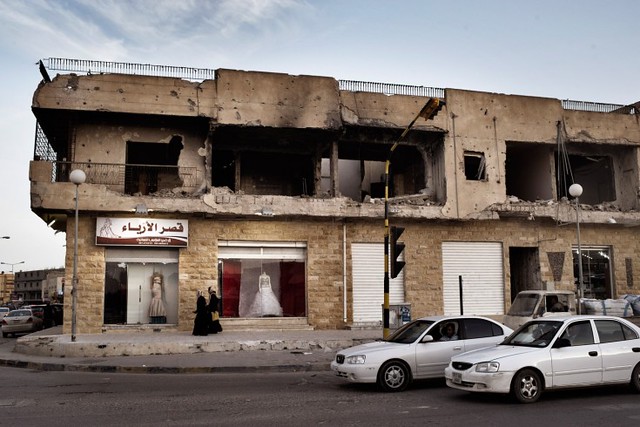
After weeks of skirmishes in the Nafusa Mountains southwest of Tripoli, Sifaw Twawa and his brigade of freedom fighters are at a standstill. It’s a mid-April night in 2011, and Twawa’s men are frightened. Lightly armed and hidden only by trees, they are a stone’s throw from one of four Grad 122-millimeter multiple-rocket launchers laying down a barrage on Yefren, their besieged hometown. These weapons can fire up to 40 unguided rockets in 20 seconds. Each round carries a high-explosive fragmentation warhead weighing 40 pounds. They urgently need to know how to deal with this, or they will have to pull back. Twawa’s cell phone rings.
Two friends are on the line, via a Skype conference call. Nureddin Ashammakhi is in Finland, where he heads a research team developing biomaterials technology, and Khalid Hatashe, a medical doctor, is in the United Kingdom. The Qaddafi regime trained Hatashe on Grads during his compulsory military service. He explains that Twawa’s katiba—brigade—is well short of the Grad’s minimum range: at this distance, any rockets fired would shoot past them. Hatashe adds that the launcher can be triggered from several hundred feet away using an electric cable, so the enemy may not be in or near the launch vehicle. Twawa’s men successfully attack the Grad—all because two civilians briefed their leader, over Skype, in a battlefield a continent away.
This is basically the Reader's Digest version of John Pollock's
People Power 2.0 published on the Libyan Tweepform yesterday. I tried to include some of the best stuff here, together with my comments, but I have left a lot of good stuff out so I strongly encourage you to read the original.
World War III or Cyber War I?
The revolutionary war to overthrow Mummar Qaddafi and free the Libyan people from his brutal regime wasn't just fought in Libya. Chiefly through cyberspace, it was fought by activist from around the world that enrolled themselves, in many cases full time, in the Libyan struggle and ended up playing a role as crucial as NATO's, if not more so. In many ways, the Libyan Revolution qualifies for the title of world war, at least on the side of the revolution.
The current
U.S. Army Field Manual for Operations says,
“information has become as important as lethal action in determining the outcome of operations.” This was completely proven by the Libyan Revolution, and this was almost certainly the first war anywhere in which activists, working through the Internet, played such a critical role in the outcome of the
military struggle. This is a very important story that is just beginning to be told.
The cyber soldiers of the revolution came from the all over the globe and the most varied walks of life.
Steen Kirby, a high school student in the state of Georgia played an important role in identifying weaponry. He also pulled together a group, through Twitter, to quickly produce English and Arabic guides to using an AK47, building makeshift Grad artillery shelters and handling mines and unexploded ordnance, as well as detailed medical handbooks which were used in the field by freedom fighters in Tripoli, Misrata, and the Nafusa Mountains.
Andy Carvin of NPR used Twitter to
crowdsource weapons knowledge. In less than 40 minutes they were able to identify unusual Chinese parachute land mines found in Misrata’s port area—their first known use in a war.
Later, at Occupy Los Angeles, I was able to apply munitions identification skills I had learned by following the work of Andy Carvin, C.J. Chivers and others in the Libyan Revolution to ID the new weapons the LAPD threaten us with on the occasion of the
BoA occupation [where I was arrested] on N17. At the time, we all thought they were tear gas guns but I was able to ID them that night as a new type
Foam Baton gun.
Stephanie Lamy was a strategic communications consultant and a single mother living in Paris. She was using the revolutions in Egypt and Libya to explain her work to her nine-year old daughter when she Googled up Libya Alhurra TV:
“When I saw the cries for help on Livestream, I knew my skills were just perfect for this situation, and it was my duty to help,” she says. She abandoned her business and started working up to 24 hours a day. It was a situation where “each action counted.”
Amen
Among other things, she became an indispensable link in an intelligence network that provided detailed information to Mustata Abdul Jalil, the Libyan Justice Minister who joined the revolution early and became chair of the National Transitional Council, about Qaddafi's troop movements and heavy weapons, including the movement of his long armored column towards Benghazi.
Why "How We Won?"
I titled this piece
"How We Won" because I believe this victory belongs not just to the Libyan thuwar, certainly not just to NATO, but equally to activist around the world that put their normal lives on hold so that they could support this struggle 24/7 by whatever means they had at hand. As Pollock said
"The war against Qaddafi was fought with global brains, NATO brawn, and Libyan blood." He gives us a picture of the military struggle relating to the decisive role played by Internet activist around the world.
So it began
On February 18, three days into the protests that would swell into the successful revolt against the regime, Libya went offline. Internet and cell-phone access was cut or unreliable for the duration, and people used whatever limited connections they could. In Benghazi, Mohammed “Mo” Nabbous realized he had the knowledge and the equipment, from an ISP business he had owned, to lash together a satellite Internet uplink. With supporters shielding his body from potential snipers, Nabbous set up dishes, and nine live webcams, for his online TV channel Libya Alhurra (“Libya the Free”), running 24/7 on Livestream.
...
In its first six weeks, the channel served 25 million “viewer minutes” to more than 452,000 unique viewers. Nabbous had only enough bandwidth to broadcast, so volunteers stepped forward to capture and upload video. Livestream took an active role, too: it archived backups several times a day, dedicated a security team to guard against hackers, and waived its fees. Others ran Facebook groups or monitored Twitter, pasting tweets and links into the chat box. They shared first-aid information in Arabic and transcribed or roughly translated interviews in close to real time.
Stephanie Lamy was one of the channel's early international supporters.
“All of us were on a fast learning curve,”
says Lamy.
“Tanks were moving in, people were getting shelled, people were getting massacred.”
On March 19, Qaddafi launched an assault on Benghazi. With shells exploding, Nabbous said,
“No one is going to believe what they are going to see right now!” before heading out to report live. He was still broadcasting when a sniper shot him. Hours after Nabbous’s death, French fighter jets strafed the heavy armor attacking Benghazi. His widow, Samra Naas, pregnant with their first child, broadcast in his place:
“What he started has got to go on, no matter what happens.” Along with friends and family, three women she had never met spent much of the night comforting her, as best they could, over Skype.
A worldwide community of activists developed around the Libyan Revolution, the new Internationale.
Among them was Charlie Farah, a Lebanese-American radio producer. She arranged technical support for Libya Alhurra TV, as well as two-way satellite subscriptions for freedom fighters. That required their trust. “When someone you’ve never met says they’ll pay for your satellite, they get your GPS coördinates,” she points out. “In the wrong hands, a missile could follow.”
She also trained the figthers, via the Internet.
Most freedom fighters were civilians with no first-aid or weapons training. Farah started teaching what she could about basic triage, planning escape routes, and how to fire and move. She showed people how to share files using YouSendIt, because guards at regime checkpoints were now searching for information being smuggled on portable media. (Rebels in Sabratha had hidden thumb drives in their hair; weapons were slung under their sheep.) For the fighters, discovery could mean imprisonment, torture, or execution.
Rida Benfayed was an orthopedic surgeon based in Denver when the war broke out. He returned to his hometown of Tobruk with getting on-line as his first priority.
Benfayed got hold of the city’s only two-way satellite Internet connection and started accepting hundreds of requests to connect on Skype. He organized his contacts into six categories: English media, Arabic media, medical, ground information, politicians, and intelligence. His contacts included ambassadors and doctors, journalists and freedom fighters. A source of high-grade military intelligence soon turned his ad hoc operation into a control room.
Someone who claimed to be a retired European intelligence officer contacted Stephanie Lamy. The detailed intelligence he sent appeared authentic: it included the number, location, and movements of Qaddafi’s troops and heavy weapons.
John Pollock goes on:
For a few weeks during the period before NATO recognized the NTC, and before the source disappeared as suddenly as he had surfaced, he was a mother lode of military intelligence. He revealed that the regime’s standard operating procedure was to cut an area’s cell-phone coverage three days before an attack; suggested strategic plans to protect Benghazi if the U.N. Security Council didn’t act; and explained how and where to attack the regime’s tanks. With Jalil’s blessing, Benfayed set up ground information links with the front lines and expanded his team to around 30 people, including opposition army, navy, and air force officers; internal and foreign media liaisons; and medical and IT specialists.
Gihan Badi was a UK based architect. Before the uprising, she was so afraid of the Qaddafi regime that she deleted all talk of February 17th from her Facebook group for Libyans.
On February 15, in a call to family in Benghazi, she learned that the protests had, unexpectedly, already started. Using a kind of pseudonym, Juhaina Mustafa, she rang Al Jazeera Mubasher, the network’s live phone-in channel, to share the news. Thanks to a connection established through her brother, she arranged interviews for Nabbous with Al Jazeera and the BBC. She began giving journalists the numbers of dozens of people in Libya, making sure to verify the trustworthiness of contacts she did not personally know. Truthful and reliable information mattered, she says, not least because “we are not faking things anymore.”
“Juhaina Mustafa” was denounced on Libyan state TV. Worried about the security of her own phone, she bought batches of prepaid phone cards. She discovered a useful rule of thumb: Qaddafi stooges making repeated Skype requests to connect with her had short fuses. “For the first three messages they are nice,” she says. “Then on the fourth they become angry and start saying, ‘We will kill you! We know who you are!’” Other contacts were patient, realizing how busy she must be. A working mother, she was now even busier and focused on a new emergency: Misrata.
Libya’s third-largest city, strategically located between Tripoli and Benghazi, was besieged. For months, heavy artillery and tanks pounded Misrata from outside. Inside, dozens of snipers—including female mercenaries from Colombia—dominated the city center. “There were dead bodies in the streets, unrecoverable because of the snipers,” says Marwan Tanton, a citizen journalist with Freedom Group Misrata, a group of students turned reporters, carrying cameras and guns. “Dogs were eating them.”
Misrata became the Stalingrad of the Libyan Revolution, and not to excuse the current treatment of people from Tawargha, who were reported to generally have supported this siege carried out from their town, but one doesn't easily get over those types of experiences.
Stephanie Lamy, Rida Benfayed, and Badi’s husband, Nagi Idris, were among many scrambling to get humanitarian supplies to Misrata and to alert the world to an unfolding disaster. They worked to smuggle in by sea the first international journalists, including Fred Pleitgen of CNN.
For NATO, the role of these cyber warriors in the military struggle was new and unsettling. Officially, they didn't use Twitter and had no contact with this activist network. In reality, a lot of information was passed back and forth between the thuwar on the ground and the NATO planners via Twitter and other Internet media, including precise targeting co-ordinates, always multiply sourced, and many NATO commanders began to rely on informal intelligence networks they had established with this activist network more than the official NATO sources. They simply got better intelligence that way.
on April 7, when—a week after assuming control of operations—NATO bombed a convoy of tanks and other armor captured by freedom fighters. There were several deaths.
Farah, Lamy, and many others had known for days that the tanks were in freedom fighters’ hands.
I knew.
Whether the incident was due simply to rebels’ being mistaken for pro-Qaddafi forces is somewhat murky. Some sources say that NATO may have been the victim of disinformation supplied by General Abdul Fattah Younes, a senior military defector later assassinated by opposition forces. Others say the freedom fighters had been warned by NATO not to cross a “red line.”
I was able to successfully "crowdsource" some of the intelligence I used in my influential diary
The Assassination of General Abdul Fattah Younis. At the time, I also wondered if Younis might have been a double agent for Qaddafi, and after his death, as the
"friendly fire" incidents died down and the months long stalemate crumbled, a story told by
Martin Sheen, my favorite actor, as
Captain Willard, in my favorite war movie,
Apocalypse Now, kept echoing in my brain:
"Late summer-autumn 1968 : Kurtz's patrols in the highlands coming under frequent ambush. The camp started falling apart...November: Kurtz orders
the assassination of three Vietnamese men and one woman. Two of the men were Colonels in the South Vietnamese army. Enemy activity in his old sector dropped
off to nothing. Guess he must have hit the right four people.
How NATO got intel
Another Libyan civilian who contributed important intelligence is a man I will call Asim (he requested anonymity because he believes that his work, providing targeting information to NATO, led directly to the deaths of people who may still have family in Libya). An influential, well-connected Libyan working in the media, Asim smuggled most of his family out of the country and then set up “op rooms” in Tunisia, Dubai, and Spain. “I don’t think any intelligence agency in the world knows Qaddafi as well as the Libyan people,” he says.
Asim’s network of information smugglers brought thumb drives and disks out of Tripoli and got approximately a hundred Thuraya satellite phones into the country. They supplied NATO with blueprints, troop locations and movements, and a detailed diagram of Qaddafi’s family connections. His estimate of Qaddafi troop numbers in Brega, between Benghazi and Misrata, came through a contact in the catering company supplying their meals.
Asim’s op rooms conveyed their intelligence to NATO, he says, via “a super-node in Dubai.” He found himself working with people in all sorts of professions, from video editors to cartographers: he remembers one “girl” he found through Twitter who “would punch in the locations of snipers on Google Maps.” The map was shared online and on the ground.
Cynthia McKinney, who loudly supported Qaddafi, saw the war from the Rixos Hotel.
In Tripoli, Qaddafi created a gilded cage in the opulent Rixos Hotel for the closely chaperoned international media. They had access to the official voice of government, but they distrusted what they were told. Yet from the start, Qaddafi’s communications had been undermined by unofficial sources: by Mo Nabbous and the Libya Alhurra TV network, by students like Freedom Group Misrata, and by the growing number of international journalists in opposition-held areas. On the ground, individuals were also blurring the line between journalism and fighting. Twenty-one-year-old Inas Mohamed, a student of English literature from Yefren, not only smuggled gelignite, an explosive, past Tripoli checkpoints but wrote, printed, shared, and scattered on the street hundreds of samizdat flyers.
These are the stories of but a handful of the hundreds, perhaps thousands, of such activists that made victory possible.
Thanks to technology, collaborators could be anywhere. In Finland, as well as helping advise on attacking Grads, Nureddin Ashammakhi set up LibyaHurra.info as a direct response to Qaddafi’s disinformation campaign. A global brigade of volunteers published daily reports from Libya in 10 languages, including Chinese, Russian, and Tamazight (the language of the Berbers, who prefer to be called Amazigh—”free people”).
This is the new Internationale.
And BTW, I would like to point out to all the so-called socialists, who largely threw the Libyan Revolution under the bus, that most of the people I have describe here are what I would call working class.
BREAKING NEWS: An hour ago Libyan Youth Movement reported that another mass grave has been found near Tripoli. This one may have up to a thousand bodies in it.

Another mass grave was discovered on Treeg Mattar (Airport Highway), Tripoli with up to 1,000 bodies; 600 were piled in groups on top of each other, some still had their mobiles on their person others had their hands tied with wire via Breaking Tripoli
Click here for a list of my other blogs on Syria


 Charles Taylor, former president of Liberia was found guilty of war crimes and crimes against humanity in Sierra Leone by the Special Court established jointly the United Nations and the government of Sierra Leone today.