Featured Post

The white-Left Part 1: The two meanings of white

Sunday, September 4, 2011

Abdul Rahman Gave his Eyes to See the End of Qaddafi

Follow clayclai on Twitter
Meet Abdul Rahman Zawawi. He is a freedom fighter from Misrata that has lost both his eyes in the revolution. He was able to get the emergency surgery he needed at a hospital in Tunis.
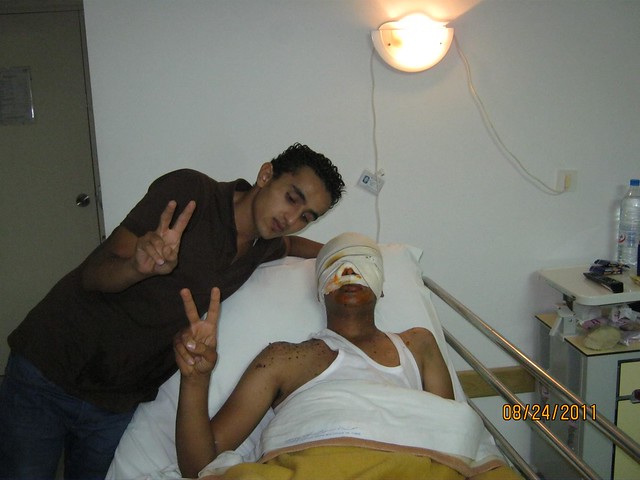
Omar with Adbu after he got out of surgery
Misrata endured months of shelling by Qaddafi's forces, including with cluster munitions. Then there was heavy fighting to end the siege. Many of the most seriously wounded have been sent to Tunis for care. As a result the situation in the Tunis hospitals is desperate and of the ICU units are packed. Only last week almost 300 new patients arrived and there was no room for them in the hospitals or clinics. Doctors are stressed out and overwhelmed with the kind of surgeries they are being asked to performed; far beyond their training.

Carol Viana and Omar AlMuktar met on Twitter during the early weeks of the Libyan Revolution and saw the needs in the hospitals early on. In July they started a project called "Postcards for Libya" where they encourage people to send get well cards and letters to Libya patients in Tunisia, mostly Tunis. Carol wrote me:
Money is an issue too. People are being discharged way too early. NTC needs to get involved. We've been trying for months to bring awareness to this but everyone was so focused on the war, it's hard to have "hospital stories."

A couple weeks ago Omar AlMuktar's own cousin from Misrata arrived in Tunis and the team for "Postcards for Libya" has been trying to get the word out on his story. Adbu, who is only 21, lost both eyes and also had his nose completely burned off. They are trying to get plastic surgery outside of Tunis.

Please visit Postcards for Libya if you can help.

Abdulrahman Zawawi, Freedom fighter from Misurata, has lost both of his eyes
??? ?????? ???????? ?? ???? ??????? ??? ????? ??????? ???? ??????? ????? ??????? ??? ??????.
In the video ..., Abdu is waking up from surgery. He holds his brother's hand and asks God to give his parents strength and patience, says he was blessed with his wounds and he is glad he gave his eyes to Libya. He says he would gladly give more if asked. He asks his brother to work hard, be successful in life and asks him always to have faith in God.
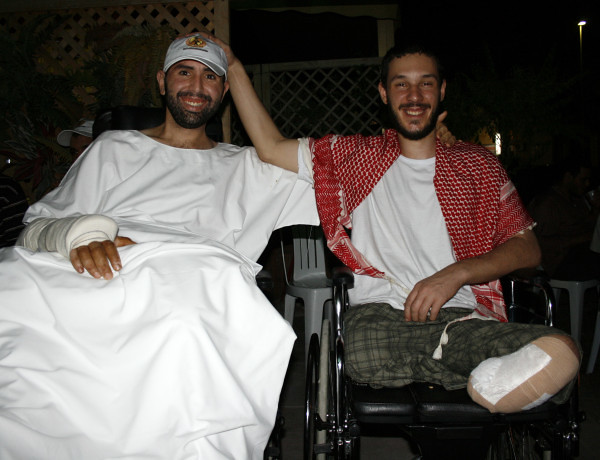
More from Postcards from Libya: Ali ,on right, and friend
Meet Ali, Misrata freedom fighter hit by Gaddafi Grad. Both legs amputated. Ali said the Grad exploded at his feet and the blast threw him 10 meters away. One of his comrades was literally cut in half. Ali was hit by that Grad on May 13. Then, due to the siege, he waited 27 days to get out of Misrata. In Ali’s group of 30 Freedom Fighters, 3 died & 7 injured from that Grad. He said their weapons range was only 5km max vs 40 for Gaddafi forces. Ali came from Misrata on a small fishing boat. It was fast but bounced a lot. During his 1st 5 days in Tunisia, Ali was treated for further damage suffered in the voyage from Misrata, not for direct injuries from the Grad. Misrata was out of anesthetics when a chunk of flesh was removed near his waist. Ali showed me how he bit a towel & clenched. On the parts of Ali’s body that remain, it looks like he was hit by a meteor shower. 100 pieces of shrapnel from the Grad. Ali said he’d been quiet & introspective before I came by. But as you can see, he became energized as we visited. July 14. Ali said he’d gladly give the rest of his body for Libya and his beloved city, Misrata. He radiates a noble passion. Visiting with Ali was a joy, but I couldn’t help weeping. He took my head in his hands, kissed it, and told me not to cry.” Via James Wheeler (@wheelertweets)
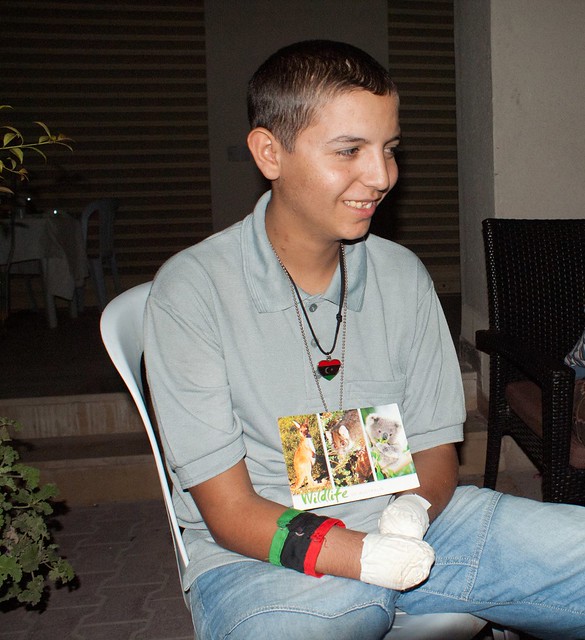
This is Aymen in Tunis, Tunisia. Aymen is a 14 year-old child who picked up a cluster bomb outside of his house in Misrata. Upon picking it up, it exploded, ripping off both his hands, tearing off the flesh of his legs, and sending shrapnel into his eye. He was so happy when he received his postcard from Australia, he asked his cousin to put the card around his neck so he could show everyone.
These are the true heroes of the Libyan revolution, not some imagery NATO spooks as the anti-interventionists would have you believe.
Click here for a list of my other blogs on Libya
7:05 AM PT: @OmarAlMuktar' real name is Suleiman A. Tawil

Friday, September 2, 2011

Libyans have spilled their blood for all of us!

I first published this diary under the title Libyans are spilling their blood for all of us on February 25th. There has been a lot of blood spilled since then but my conclusions remain the same. So this would seem like a good time to republish it and to thank the Libyan people. Their blood sacrifice will ultimately mean less death and destruction for the rest of us. Now that Qaddafi has been put out of power, expect changes for the better in Syria, Yemen and Bahrain. Also look for positive develops all over Africa in coming years now that Qaddafi's heel has been removed from her neck. You can count on it.


The brute force approach to popular uprisings is now being tried in earnest in Libya. In using artillery, aircraft and navy on peaceful protesters Colonel Gaddafi is attempting to break the protest movements with massive violence.

If he is successful, this type of violent response to popular uprising will almost certainly be used elsewhere with all the terrible consequences for humanity. If he fails and is hopefully executed for his war crimes, the reigning powers around the world will favor more peaceful methods of resolving contradictions.

Colonel Gaddafi is not the only head of state that counts human life cheap. What he has been doing this week using large caliber military weapons against unarmed civilians, US Presidents do as a matter of course, week in and week out. This week US air assaults on the Afghan village of Heelgal killed 64 civilians including many children according to Afghan President Karzai. It was hardly noticed because the spot light is on the innocent blood being spilled by Gaddafi this week and because, with an estimated 8 million civilians killed by the US military since the Korean War, US presidents using military power on civilians isn't exactly news.

When Secretary of State Clinton made the rounds on the TV talk shows Sunday morning talking about events in Libya and complaining that it is wrong to turn to violence to solve political problems, most of the world knew they were listening to a hypocrite. The United States has led the world in using massive violence to resolve political problems.

Nor am I implying that the other world leaders are any less squeamish in applying massive violence if it will resolve their political problems. What I am saying is that the abhorrence for Gaddafi's violence that has been displayed by most world leaders, including our own, is mostly for public consumption.

They know that we are facing a world economic crisis of historic proportions. It's root cause is a world economy that has been organized to benefit a select handful at the expense of the majority. This system has insurmountable internal contradiction that cannot be solved unless the rich and powerful are dispossessed and the world economy is re-organized to benefit the world.

They are having none of that. They will fight that with their last dying breath. The other day an Indiana Official suggested that peaceful protesters in Wisconsin be shot. They are like Gaddafi on a world scale in that they would sooner bring disaster and suffering for all rather than give up their privilege.

In Tunisia the general of the army refused to use massive violence on the protesters and the revolution succeeded in ousting the dictator. In Egypt the junior officers refused to open fire with their tanks and the revolution succeeded in ousting the dictator. And while all the leaders of the US, UK and EU are now claiming to welcome and even champion these popular democratic movements, it is a sham. That's not why they have supported these dictators all these years.

If massive violence can contain the wave of mass rebellions that now has reached even the state house in Wisconsin, they won't mind the bloodshed. They just haven't had the opportunity yet. Gaddafi gives them that opportunity.

That is why they have so far been so anemic in their response to Gaddafi. They secretly want him to succeed. They are hoping he will succeed and they won't act until it is clear to all [as is quickly becoming the case] that he has failed. You can count on it. {and we now know, they allowed another 3 weeks of this horrific violence, and took action only after the protesters had taken up arms, and they were faced with a humanitarian crisis in Benghazi.} If he can put a lid on things, restore the status quo and with it, the oil flow, they may put him back on the pariah list but they will allow him to stand and continue to do business with him.

This is a test and fate or history has selected the Libyan people to take it. But all of us will be drastically affected by the outcome. The unarmed Libyan protesters that have braved machine gun, anti-aircraft and artillery fire to take many of Gaddafi's fortresses around the country are giving their all, their very lives in many cases, to show that even massive violence won't stop the people's movement forward.

If Gaddafi's violence fails Governor Scott will negotiate with the demonstrators in the Wisconsin state house, if it succeeds he will send in the police. If Gaddafi's violence succeeds, many more will die in Yemen and Bahrain and everywhere else that people resist tyranny. If he fails, the powers that be everywhere on the planet will be less likely to follow his lead and try a massive violence approach.

Those brave Libyans who fate chose to brave machine gun fire to win their freedom are braving that machine gun fire for all of us.
Click here for a list of my other blogs on Libya

The True Story Behind the WikiLeaks Cable Dump

Last year, as both legal and extra-legal threats against WikiLeaks and Julian Assange grew, they took out an what they called an "insurance policy" to insure that the full dump of state department cables would get out. That took the form of an encrypted, compressed file of all the cables. This was before WikiLeaks or it's media partners had time to go through them so these were un-redacted cables. They made this file widely available on the Internet. As a matter of fact, I publicized the link in one of my earlier DailyKos diaries.

Since the file would be useless without the pass key, that alone did not release the cables but it did assure that should something drastic happen, say Julian should meet with a mysterious accident, by simply releasing the key, the cables could be made public.

I'll let Bernice Keane take it from there:
The problem was, the password was made available, by none other than The Guardian’s David Leigh, in his book released in February this year co-written with Luke Harding, WikiLeaks: Inside Julian Assange’s War on Secrecy. An extract from the book, which was published after the encrypted material had gone online:

Eventually, Assange capitulated. Late at night, after a two-hour debate, he started the process on one of his little netbooks that would enable Leigh to download the entire tranche of cables. The Guardian journalist had to set up the PGP encryption system on his laptop at home across the other side of London. Then he could feed in a password. Assange wrote down on a scrap of paper:

CollectionOfHistorySince_1966_ToThe_PresentDay#

“That’s the password,” he said. “But you have to add one extra word when you type it in. You have to put in the word ‘Diplomatic’ before the word ‘History’ Can you remember that?” “I can remember that.” Leigh set off home, and successfully installed the PGP software.

Leigh thus, as part of his effort to cash in on his once-intense but by then-soured relationship with Assange, had revealed the key to decrypting the entire set of cables that had been available online.

The book was published last February but it took a while for someone to put one and two together and make three. When they did the cat was out of the bang.

The Guardian for it's part claims they had been told that the pass phase would expire and be deleted. The Guardian's solution was for WikiLeaks to "remove the files" that they had put up for download. Somebody needs to keep them away from computers. They simply don't understand these things.

For WikiLeaks, it then became a question of attempting to control this process or not. They decided to get ahead of the imminent hostile or uncontrolled release and attempt to control it.

This accounts for the sudden release of over 100,000 cables in recent weeks and the setting up of #wlfind and the final release of the full quarter million unredacted cables yesterday.

Keane again:
Shortly before deadline, Wikileaks was conducting a global consultation to determine if it should release the unredacted cables itself, with nearly all opinion favouring release.

I'll leave the parsing of blame to the comment section. I've read WikiLeaks Exposes Thousands Of Informants and heard a lot of confusing news reports. So I thought you deserved a simple telling of what happened.

From there you'll have to make up your own mind.

Thursday, September 1, 2011

Film Premiere of "We Win Or We Die"

Follow clayclai on Twitter
Director Matthew Milan traveled to Benghazi, Libya and collected some great material about the beginning of the Libyan Revolution from February 18th - 22nd. The title of this excellent documentary in "We Win Or We Die." He has it slated for a Sundance premiere but on August 20, 2011 I was lucky enough to attend a work-in-progress screening and discussion at Venice Arts. This is the video they produced about that event. I can be heard but not seen talking during the Q&A. Be warned. This is a 50 minute video but well worth your time.
Below is a 1 minute trailer for We Win or We Die He needs your help to finish this film, which had the working title "West of Tobruk: The Libya Uprising." Here's his pitch:
Our Story Follow Matthew Millan, a documentary filmmaker who is going into the lion's den to capture the very heart of the Libyan uprising. From the revolution's onset reflected in the heroic actions of a 49 year old suicide bomber to the current lingering stalemate, Mr Millan will travel to Benghazi to discover the true tipping point that caused an entire region to shed its yoke of 42 years of oppression. And from the interviews of the average people caught up in this war, we will see what caused them, in essence, to cross the Rubicon, the intangible point of no return. From the eastern city of Tobruk to the rebel stronghold of Benghazi, Mr. Millan journeyed into the heart of a nebula coalescing from the dust of war...and into a nation reborn. Amidst the brutality and devastation wrought under 42 years of Gaddafi’s rule, a civil society par excellence is emerging from the ashes. And for the first time in their lives, the eastern Libyans feel a strong sense of citizenship, finding themselves gravitating toward certain roles, roles they would never consider five months before. Medical students turned news anchors. Civil engineers turned newspaper editors. And taxi drivers turned soldiers. Neighborhoods have banded together to pick up the pieces of a shattered infrastructure. Children sweep the streets after the witching hour, alongside men who paint the roadside curbs. Looting is non-existent, and the crime rate has dropped by a factor of 20… and this in the absence of strong government. The Impact 'West of Tobruk' is very much a human story, and will reveal to the audience just who these rebels who chose to stand against tyranny are. We in the West will benefit in seeing those with the same hopes and aspirations...to shed the manacles of brutal, merciless oppression...and forge their own destiny. This film will remind us that no matter the borders, the boundaries, nor the beliefs, we are all human and should decry injustice wherever we may see it. But this is a much bigger story. Much bigger than any one person...much bigger than any one country...and even much bigger than any one region. 'West of Tobruk' shall paint for the audience a greater context, and ring the echoes of a century. Paradigms are shifting with tectonic force, and with that new ideologies are emerging. The borders drawn by post-war colonialism are being dissolved, and an Arab nation is emerging from the ashes. 'West of Tobruk' will elucidate on how the Libyan uprising, and its kindred rebellions throughout the region, spell the real conclusion to the First World War, and a final closing of the 20th century. Please view all of the Libya reports that I made between April and May of 2011. You will get an idea of the extraordinary events occurring in the East right now. Visit us at: http://www.youtube.com/user/180filmsnetwork?fea... What We Need & What You Get In order to finish the film, I will need at least $12,000. This includes going back to Libya to investigate further into formation of a nation amidst the dust of war. Further, some of the funds will go to the task of finishing the film. This includes the rest of the production, and the post-production stages.. I will spend a further 8 weeks in Libya, where I will travel deep into the desert, journey to historic sites of the region, and interview a wide variety of people. $12,000 is a very low estimate, but will be a good catalyst to finsih the project, and give to you one of the most riveting stories of our time. Other Ways You Can Help Please let everybody know about this amazing project. The uprisings in the Middle East and North Africa are much closer to home than you may believe, and will have a colossal impact on the geopolitical climate for decades to come. These stories shall ring throughout history...and it is no coincidence that they are occurring near the heart of where civilization began. So tweet about it, post it on Facebook, email, or use carrier pigeons if you have to. Just please ge the word out, and make this film possible. Thank you for all of your support.
Here is his website.
Click here for a list of my other blogs on Libya

Wednesday, August 31, 2011

Secret files reveal Dennis Kucinich talks with Qaddafi Regime


Today Jamal Eishayyal reported in Al Jazeera/English that he found some papers in the office of Abdullah Alsinnousi, head of Libya's intelligence service and one of the most fear men in Libya, that seem to document the communications of several prominent US citizens with the Qaddafi regime in the months before it was overthrown. The following information request is said to be from Congressman Dennis Kucinich:
Good Morning Gentlemen.
This is the Congressman you both spoke with. He is going to fight for us but he has asked us for evidence. I can bring whatever we can gather. If it is sensitive I will carry it, otherwise we can email it. House to vote next week on ending US involvement in Libya

l.Any corrupt (verifiable) acts by the Opposition leaders. Include any personal motives for instance to make money or gain certain types of power.
2.Any known Al-Qaeda operating in the Opposition.
3 .Any evidence of atrocities committed by the Rebel soldiers.
4-.Any evidence of Civilian deaths by NATO.
5 .Any evidence of arms sales to the Opposition in Benghazi or Misrata, including dates, who sold the weapons, what type and the cost of the deals.
6.Any evidence of weapons being smuggled on boats to Misrata, with dates. and type of weapons.
7.Any evidence that the uprising was a planned event prior to February 17th. Include intercepted communications, names, dates.
S.Evidence supporting that the Regime has a regular practice of hiring African military in its Pan-African units and this was not a new (mercenaries) thing just for the uprising.
9.Communications with the UK and USA prior to the UN bombings to show Regime was trying to negotiate peacefully.
10.Evidence of cease fires by the Regime or withdrawals of troops. Dates, location, description (including why cease fire broke down).
11.Evidence that before the uprising started, there were democratic projects under way, for instance a plan for elections and so forth. This shows that they were already going this way and aren't just saying that now.
l2.Evidence that The Leader had already planned to step down before the uprisings. This shows there was already a transition going on. It also helps him save face for when he does step down because it will look like that was the plan all along.
l3.A list of tribes and location known to be loyal to Regime, those pledging loyalty to Opposition, and the remaining ones that have not pledged either way. The population of each group as well, This shows that the Rebels don't have the full support of the country.
l4.A list and description (including date and location) of humanitarian efforts by Regime since this started, or their attempts to aid the civilian population, and any efforts blocked by NATO or the Rebels.
It will be used for:
A) A lawsuit against
B) Defending Saif in the ICC
C) Publicity to reform the image of Regime.
D) To help negotiation positions

At the time Kucinich was attempting to get passed a resolution which he authored that would mandate an immediate withdrawal of US forces from Libya absent congressional authorization. Dennis Kucinich has issued a response to this news to the Atlantic Wire:
"Al Jazeera found a document written by a Libyan bureaucrat to other Libyan bureaucrats. All it proves is that the Libyans were reading the Washington Post... I can't help what the Libyans put in their files... Any implication I was doing anything other than trying to bring an end to an unauthorised war is fiction."
While that reply would seem to indicate that this communication was a fabrication, earlier this week, Kucinich issued a press release defending his search for peace in Libya and confirming his contact with the Qaddafi regime:
Washington, Aug 26 - The Guardian newspaper recently reported that it found communications between me and an intermediary regarding a possible visit to Libya.

From the beginning of the conflict, I have led the effort in challenging the Obama Administration’s war in Libya and to seeking a just, peaceful resolution to the conflict. My opposition to the war has been well-known, including through a number of pieces published in The Guardian.

In my efforts to end the war, I have been contacted by many parties – including members of the Gaddafi regime and some with ties to the rebels. Reaching a just and peaceful solution requires listening to all sides.
The Guardian article Kucinich is referring to is one published earlier this week and speaks of other found secret papers about an attempt to arrange a meeting between the Congressman and officials of the Qaddafi regime. The Guardian wrote:
On 22 June a letter sent to Libya's prime minister, Al-Baghdadi Ali al-Mahmoudi, by a US-based lobbyist for the regime, Sufyan Omeish, noted that Kucinich was "concerned that his personal safety in Tripoli could not be guaranteed". He preferred to conduct meetings with regime officials outside Libya. The plan was for Kucinich to meet "senior Libyan officials, including Gaddafi". The proposed trip never took place. Kucinich visited Syria instead.
The Al Jazeera article also reports on another document the appeared to be the minutes of a meeting between David Welch, former assistant secretary of state under George W Bush, and senior Libyan officials Abubakr Alzleitny and Mohammed Ahmed Ismail on August 2, 2011 at the Four Seasons Hotel in Cairo, a few blocks from the US embassy. Welch was advising the Qaddafi regime on how to win the propaganda war.

Copies of the documents can be found on the Al Jazeera website at the above link. As the once secret business of the Qaddafi regime becomes public knowledge we can expect to get a much clearer picture of the workings of that regime as well as it's connections to it's US supporters.

Here is Al Jazeera's video report:
This diary posted a little before mine and has a very lively comment section: Documents Found in Libya Say Dennis Kucinich Offered to Help Qaddafi UPDATE - Wednesday, Sept 1, 2011: We have this additional info from Politco:
Kucinich told The Guardian that he had held an hour long telephone conversation with Libyan Prime Minister Al Baghdadi Ali al-Mahmoudi but ended up deciding to visit Syria, another country in the throes of protest against a violent dictator.
Hour long? Could this be the conversation recorded in the memo? Politico continues:
At first, Kucinich did not publicize his trip to Syria, in which he met with Syrian leader Bashar al-Assad. Rather, he was first spotted in Damascus by a CNN correspondent. Soon thereafter, he gave a press conference to Syrian media in which he was quoted as saying, “President Bashar al-Assad cares so much about what is taking place in Syria, which is evident in his effort towards a new Syria and everybody who meets him can be certain of this.” Kucinich later disputed this reporting, saying that his message was lost in translation from Arabic.
I find it extremely interesting that Kucinich intended to keep his trip to Syria a secret. Why was he going there? We know from other reports [see above] that he refused a meeting with Qaddafi officials because he felt it was "unsafe" and suggested a meeting outside of Libya. Now, where could such a meeting take place given the ICC indictments and the travel ban on Qaddafi officials? This raises the question of Kucinich's conduct if his trip to Syria involved a covert meeting with Qaddafi's representatives violating the travel ban or avoiding arrest. Might that be criminal? More on Kucinich's defense of Qaddafi: Kucinich on NATO in Libya: ‘Gangsterism’
Rep. Dennis Kucinich, D-Ohio, may have gone too far even for the Puget Sound peaceniks he is courting as a potential carpetbagger candidate for Congress in Washington. As much of the world celebrated the apparent fall of Libya’s Col. Gaddafi, Kucinich on Tuesday released a statement calling for NATO commanders to be hauled before the International Criminal Court. “If members of the Gaddafi Regime are to be held accountable, NATO’s top commanders must also be held accountable through the International Criminal Court for all civilian deaths resulting from bombing,” said the seven-term Cleveland congressman. “Otherwise, we will have witnessed the triumph of a new international gangsterism.” Kucinich delivered a spirited defense of the dictator’s foreign policy while claiming he does not “sympathize with Colonel Gaddafi’s brutality.” He also seemed to blame foreign investment for social conditions that led to the anti-Gaddafi rebellion. “On December 19, 2003, Libya voluntarily gave up its nuclear weapon-making capability and on January 6, 2004 ratified the Comprehensive Test Ban Treaty,” he wrote. “Its relationship with the US on the mend, Libya then opened up to international investment and began the wholesale privatization of its industries, leading to massive unemployment and dissatisfaction with the state of things, particularly among younger Libyans.”

Click here for a list of my other blogs on Libya